Solar Battery Storage for Home: Key Buying Tips
Discover how solar battery storage for home systems can slash your electric bills, keep your lights on during outages, and boost your energy independence.

By Dylan Harris
Learn more about Solar Panel Installation and Repair for guides, costs, and what to expect.
Compare Solar Panel Installation and Repair Pros Near You

Enter your ZIP code to compare top-rated local professionals and request free quotes.
The sun sets, your solar panels go quiet, and your home draws power from the grid again. That is the moment when a solar battery changes everything. Instead of sending your extra daytime energy back to the utility for a small credit, you store it and use it after dark. Solar battery storage for home use is no longer a futuristic luxury. It is a practical upgrade that can cut your electric bill, keep your lights on during outages, and reduce your carbon footprint. This guide walks you through how home battery systems work, what they cost, and how to choose the right one for your house.
How Solar Battery Storage Works
A solar battery is essentially a large rechargeable battery that connects to your solar panel system. During the day, your panels often produce more electricity than your home consumes. Without a battery, that surplus flows back to the grid, and you receive a net metering credit from your utility. With a battery, the surplus charges the battery instead. When your panels stop generating at night, the battery discharges to power your home.
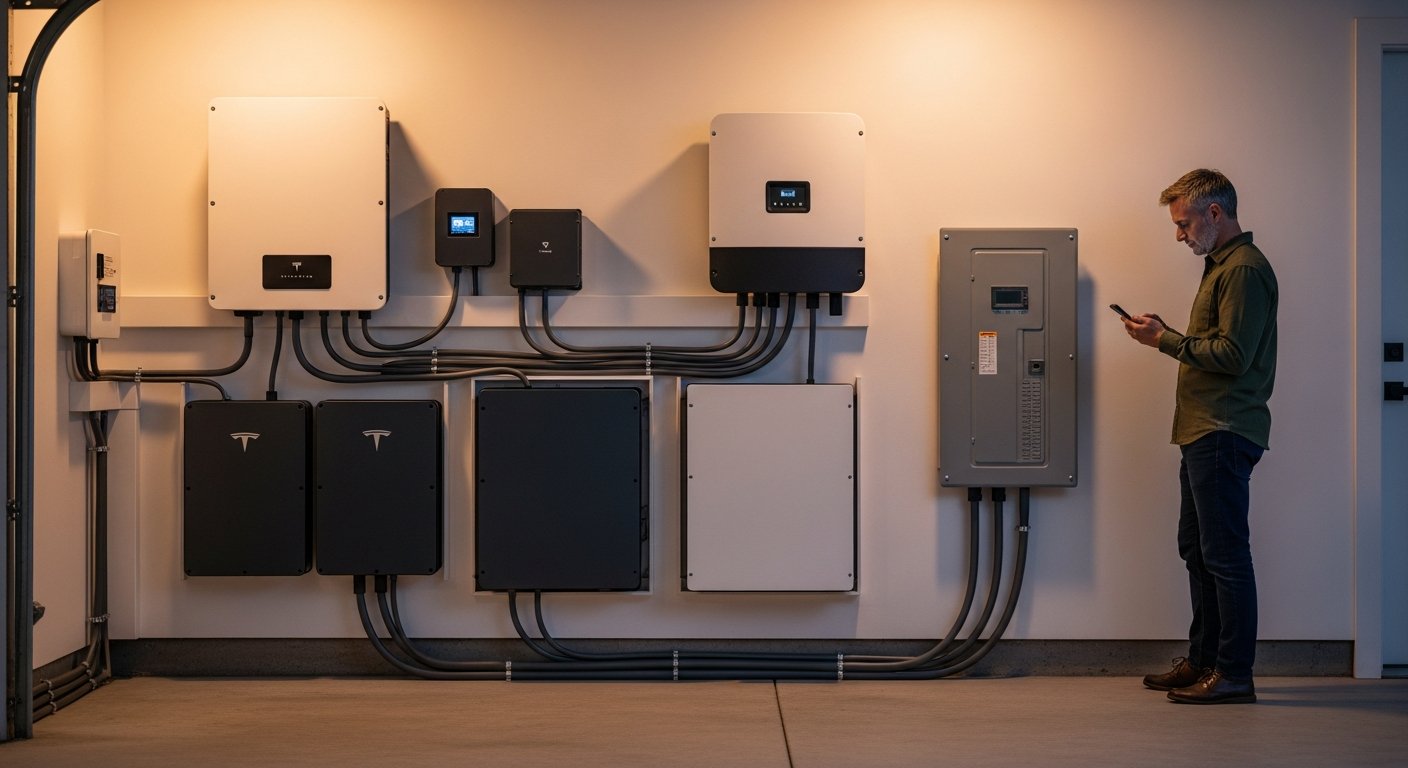
Most modern home batteries use lithium-ion chemistry, the same technology found in electric vehicles and smartphones. They are compact, wall-mounted units that can be installed in a garage, basement, or exterior wall. The battery system includes an inverter that converts the stored DC power into the AC power your home appliances need. Some systems, like the Tesla Powerwall and LG Chem RESU, come with their own integrated inverter. Others, such as the Enphase IQ Battery, pair with a separate inverter or work with your existing solar inverter.
The heart of the system is the battery management software. It monitors your energy production, consumption, and battery state of charge. It decides when to charge, when to discharge, and how much power to send to your home versus the grid. Advanced systems can even learn your daily routines and optimize energy use to maximize savings. For example, they can charge the battery during off-peak hours when electricity is cheap, then run your home on battery power during peak hours when electricity is expensive.
Why Add a Battery to Your Solar System
There are two primary reasons homeowners add battery storage: backup power and financial savings. Let's break down both.
Backup Power for Outages
If you live in an area prone to severe weather, rolling blackouts, or an unreliable grid, a battery gives you peace of mind. When the grid goes down, your solar panels alone cannot power your home unless you have a battery. In fact, most grid-tied solar systems automatically shut off during an outage to prevent backfeeding electricity to utility workers. A battery with islanding capability allows your home to disconnect from the grid and run on stored solar energy. You can keep your refrigerator, lights, Wi-Fi, and medical devices running for hours or even days, depending on your battery size and usage.
Financial Savings and Energy Independence
Batteries also save money by letting you use more of the solar energy you generate. Instead of exporting excess power to the grid for a low credit rate, you store it and use it when utility rates are highest. This is especially valuable if your utility uses time-of-use (TOU) rate plans, where electricity costs more during peak demand hours (typically late afternoon and evening). A battery lets you avoid those peak rates by drawing on stored solar energy.
Batteries also increase your energy independence. You rely less on the grid and are shielded from rising electricity rates. Over time, the savings on your electric bill can offset the upfront cost of the battery, though the payback period varies widely by location, utility rates, and battery cost. In some states, like California with its Self-Generation Incentive Program, rebates can significantly shorten the payback period.
What Does a Home Solar Battery Cost?
The cost of a solar battery is one of the biggest factors homeowners consider. As of 2026, the average installed cost for a home solar battery ranges from $7,000 to $15,000 before incentives. This includes the battery unit, inverter, installation, and permits. The final price depends on the battery capacity (measured in kilowatt-hours or kWh), the brand, and the complexity of the installation.
For example, a single Tesla Powerwall (13.5 kWh) typically costs around $11,500 installed. A smaller battery like the Enphase IQ Battery 10 (10 kWh) might cost $9,000 to $12,000. If you need more capacity, you can stack multiple batteries, but each additional unit adds cost. Installation costs range from $2,000 to $5,000, depending on whether you need a new subpanel, electrical upgrades, or a wall mount for the battery.
Fortunately, federal and state incentives can reduce the net cost. The federal Investment Tax Credit (ITC) offers a 30% credit on the total cost of a solar battery system, provided it is charged by solar panels. Many states also offer additional rebates or performance-based incentives. For example, Massachusetts, New York, and California have programs that can cut thousands of dollars off the upfront price. Always check the Database of State Incentives for Renewables and Efficiency (DSIRE) for your state's incentives, and confirm with a tax professional how the ITC applies to your situation.
How to Size a Solar Battery for Your Home
Choosing the right battery size is critical for both performance and cost. If you buy too small, you won't have enough backup power or savings. If you buy too large, you waste money on unused capacity.
Here is a simple three-step process to estimate your needs:
- Calculate your daily energy usage. Look at your electricity bill to find your average daily kWh consumption. A typical American home uses about 30 kWh per day.
- Decide what you want to power. For whole-home backup, you need enough capacity to cover your daily usage, which might be 20 to 30 kWh. For essential loads only (refrigerator, lights, outlets), you might need only 5 to 10 kWh.
- Factor in your solar production. If your solar panels produce more than you use during the day, you can charge the battery fully. If not, you may need to size the battery to store only what you can generate.
A good rule of thumb is to choose a battery that holds at least one day of your essential energy usage. If you experience frequent, long outages, consider two days of storage. Battery capacity is also affected by the depth of discharge (DoD). Most lithium-ion batteries can be discharged to 80-90% of their rated capacity without damaging the battery. So, a 13.5 kWh battery realistically gives you about 11-12 kWh of usable power.
To give you a concrete example, consider a family that uses 25 kWh per day. They want to power their refrigerator (1.5 kWh/day), lighting (2 kWh/day), and home office (3 kWh/day) during an outage. That's about 6.5 kWh per day. A single 10 kWh battery would be sufficient for one day of backup. For whole-home backup, they would need two or three batteries, depending on how many days of autonomy they want.
Key Features to Compare in a Solar Battery
Not all batteries are created equal. When comparing models, focus on these features:
- Usable capacity: This is the actual amount of energy you can draw from the battery, not the theoretical rating. Look for a high usable capacity.
- Power output: This is the maximum amount of power the battery can deliver at once, measured in kilowatts (kW). It determines how many appliances you can run simultaneously. A higher continuous power rating is better for running heavy loads like air conditioners.
- Round-trip efficiency: This is the percentage of energy that comes out of the battery versus what goes in. Higher efficiency means less energy wasted. Look for at least 90% efficiency.
- Warranty: Most lithium-ion batteries come with a 10-year warranty. Check the terms for throughput (how much energy can be cycled) and end-of-warranty capacity retention (usually 70-80%).
- Scalability: Can you add more batteries later? Some systems limit the number of batteries you can install, while others allow unlimited expansion.
- Smart features: Look for apps, monitoring, and integration with smart home systems. Some batteries offer time-of-use scheduling, storm watch alerts, and even AI-driven optimization.
One feature that is becoming increasingly popular is AI-powered energy management. Systems like the SolarEnergy.ai smart battery controller learn your habits and automatically shift loads to maximize savings. They can pre-heat your water heater before a rate hike or charge your car when solar production peaks. This type of intelligence can add up to significant annual savings.
Installation Considerations and Costs
Installing a solar battery is not a DIY project for most homeowners. It involves high-voltage electricity, permits, and utility interconnection agreements. You should hire a licensed electrician or solar installer with experience in battery installations. They will assess your electrical panel, determine the best location for the battery, and handle all necessary permits.
Before installation, check if your utility has any specific requirements for battery systems. Some utilities require a separate meter or a disconnect switch. Others have limits on the size of the battery or how it can be charged. Your installer should be familiar with local regulations.
The installation process typically takes one to two days. The installer will mount the battery, connect it to your solar system and electrical panel, and configure the software. After installation, a city inspector will often need to approve the work, and your utility may need to sign off before you can turn the system on. In some areas, this approval process can take several weeks.
Battery Lifespan and Maintenance
Solar batteries are designed to last 10 to 15 years, which is less than the 25-year lifespan of solar panels. The battery's capacity gradually declines over time as it cycles. Most manufacturers guarantee that the battery will retain at least 70% of its original capacity after 10 years or a certain number of cycles (usually 5,000 to 10,000 cycles). At the end of its life, the battery can often be recycled in specialized facilities.
Maintenance is minimal. You don't need to water or clean the battery. The battery management software automatically balances the cells and protects the system from overcharging or deep discharges. You should keep the battery area free from dust and debris, and ensure it has proper ventilation. Most systems come with a mobile app that shows you real-time energy flow, battery health, and alerts for any issues.
One thing to watch is the battery's state of charge during extended outages. If you use too much power without recharging, the battery can drop to a critical level. Most systems allow you to set a reserve limit, so the battery always keeps a small amount of energy for emergencies. You can also program the system to start charging the battery from the sun as soon as the grid goes down, so you don't run out.
How to Get the Best Value from Your Battery
Once your battery is installed, you can take steps to maximize its value. Start by understanding your utility's rate structure. If you have time-of-use rates, program your battery to discharge during peak hours and charge during off-peak hours. If your utility offers a net metering program, consider whether it is more beneficial to export excess solar or store it. In some areas, the export credit is so low that storing is always better.
You can also use your battery to participate in demand response programs. Some utilities offer bill credits for allowing them to draw power from your battery during grid emergencies. This can generate extra income while supporting grid stability. Check with your utility to see if they have such a program.
Finally, consider pairing your battery with other smart home devices. For example, a smart thermostat can lower your HVAC usage when the battery is low. A smart EV charger can charge your car during solar peak hours. By integrating these systems, you can further reduce your grid reliance and save money.
Is Solar Battery Storage Right for You?
Solar battery storage for home is not a one-size-fits-all investment. It makes the most sense if you experience frequent power outages, have high electricity rates, or live in a state with strong incentives. If your utility has net metering that pays you full retail rate for your excess solar, a battery may not offer a strong financial return. But if net metering is being phased out or your utility charges demand fees, a battery can be a smart hedge.
To decide, start by calculating your current electricity costs and your solar production. Use free online tools like the SolarEnergy.ai savings calculator to estimate your potential savings with a battery. Then, get quotes from at least three reputable installers. Compare not only the price but also the battery features, warranty, and the installer's reputation.
Remember that a battery is an investment in resilience and independence. Even if the payback period is longer than you'd like, the ability to keep your lights on during a storm or avoid peak rates can be worth the cost. And as utilities continue to raise rates, the financial case for batteries will only strengthen.
Before you buy, read more in our solar battery buying guide to compare popular models. You can also check our solar battery guide for a deeper dive into sizing and costs. And if you're ready to move forward, our choosing the right storage article explains how to evaluate installers.
The decision to add a battery to your home solar system comes down to your priorities. If you want peace of mind, lower peak-time bills, and a smaller carbon footprint, a solar battery is a compelling choice. With the right size, features, and installation, it can transform your home into an energy-resilient haven. Take your time, do your research, and soon you'll be enjoying the benefits of stored sunshine.