Solar Battery Guide: Choosing the Right Home Storage
This solar battery guide explains how home storage works, which battery chemistry to choose, how to size a system, and what incentives can reduce costs.

By Ethan Contributor
Learn more about Solar Panel Installation and Repair for guides, costs, and what to expect.
Compare Solar Panel Installation and Repair Pros Near You

Enter your ZIP code to compare top-rated local professionals and request free quotes.
When the sun sets, your solar panels stop generating electricity. Without a battery, you rely on the grid or you waste the excess power your system produced during the day. A solar battery changes that equation. It captures surplus energy, stores it for later use, and gives you real control over your home's electricity. This solar battery guide walks you through everything you need to know, from how batteries work to which chemistry fits your home, how to size a system, and what incentives can lower the upfront cost.
How a Solar Battery Works with Your Home
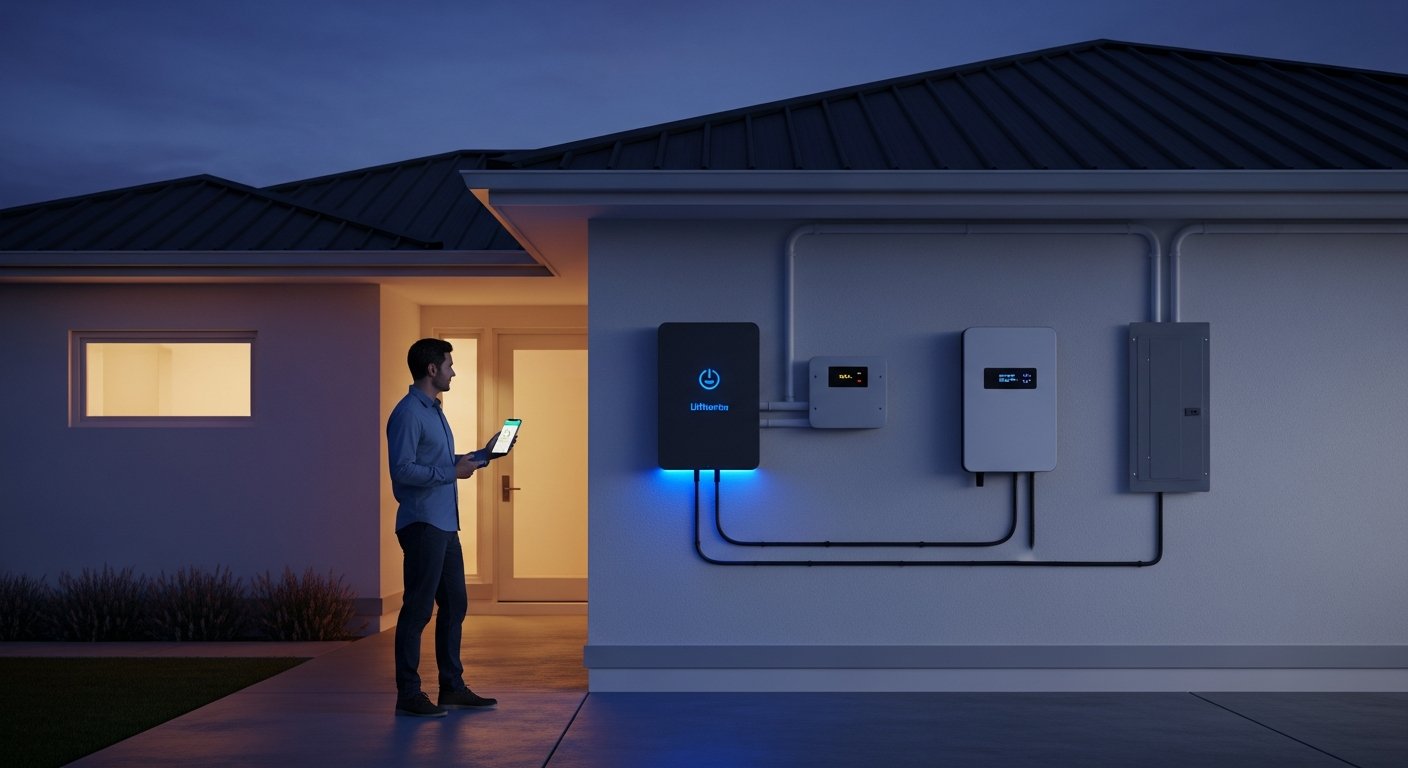
A solar battery is essentially a large rechargeable lithium-ion (or sometimes lead-acid) pack that connects to your solar panel system and your home's electrical panel. During daylight hours, your panels generate direct current (DC) electricity. An inverter converts that DC power into alternating current (AC) for your home. When your panels produce more electricity than your home consumes, the excess power charges the battery instead of sending it back to the grid.
At night or during a power outage, the battery discharges its stored energy through the inverter, supplying your home with clean, solar-generated electricity. This process happens automatically with modern systems. You can monitor everything through a smartphone app, tracking how much energy you have stored, how much you are using, and how much you are saving each month.
Key Benefits of Adding Battery Storage
Adding a battery to an existing or new solar array offers several practical advantages. Understanding these benefits helps you decide whether storage is worth the investment for your household.
- Energy independence: You rely less on the utility grid and protect yourself from rising electricity rates.
- Backup power during outages: Critical appliances like refrigerators, lights, and medical devices stay on when the grid goes down.
- Maximized solar investment: You use more of the energy your panels produce instead of exporting it at low feed-in tariffs.
- Time-of-use savings: You can charge the battery when electricity is cheap and discharge during peak-rate hours.
- Reduced carbon footprint: Stored solar power means you burn less fossil fuel-generated electricity from the grid.
Each of these benefits ties directly to your specific utility rates, local grid reliability, and energy consumption patterns. For example, if your utility offers net metering at a one-to-one rate, the financial case for a battery shifts compared to a location with low export rates or frequent blackouts.
Solar Battery Chemistries: Lithium-Ion vs. Lead-Acid
Most modern solar batteries use lithium-ion chemistry, but older systems sometimes use lead-acid. Each type has trade-offs that matter for your home.
Lithium-Ion Batteries
Lithium-ion batteries dominate the residential market for good reason. They offer higher energy density, meaning they store more power in a smaller physical footprint. They also have a longer lifespan, typically 10 to 15 years, and a deeper depth of discharge (DoD). Most lithium-ion batteries can discharge 80% to 90% of their stored energy without damaging the cells. They also charge faster and require almost no maintenance. The main downside is higher upfront cost, though prices have dropped significantly in recent years.
Lead-Acid Batteries
Lead-acid batteries have been used in off-grid solar systems for decades. They cost less upfront but have a shorter lifespan, usually 3 to 7 years, and a lower DoD of around 50%. You cannot discharge them as deeply without shortening their life, so you need a larger bank to get the same usable capacity. They are also heavier, require ventilation, and need periodic maintenance like checking water levels. For most grid-tied homeowners, lithium-ion is the better long-term value.
How to Size a Solar Battery for Your Home
Sizing a battery correctly is critical. Too small, and you run out of power during an outage or fail to capture enough solar surplus. Too large, and you waste money on capacity you never use. Start by looking at your electricity bills to find your average daily consumption in kilowatt-hours (kWh). A typical U.S. home uses about 30 kWh per day, but your number could be higher or lower depending on appliances, HVAC, and family size.
Next, decide what you want the battery to do. If your goal is backup power for essential loads, list the appliances you need during an outage. A refrigerator uses roughly 1.5 kWh per day, lights might use 1 kWh, and a sump pump or medical device adds more. Add up the daily needs of those critical loads, then choose a battery with usable capacity that covers at least one full day. If your goal is time-of-use arbitrage or maximizing self-consumption, look at your solar production data and your evening usage. Many homeowners find that a 10 kWh to 15 kWh battery balances cost and coverage well for grid-tied homes.
For professional guidance on sizing and configuration, check out our Solar Battery Guide: Choosing the Right Home Storage which walks through specific scenarios and matching battery size to your solar array.
Round-Trip Efficiency and Depth of Discharge
Two technical specifications matter when comparing batteries: round-trip efficiency and depth of discharge. Round-trip efficiency measures how much energy you get back relative to what you put in. A battery with 90% efficiency means for every 10 kWh you charge, you can use 9 kWh. The other 1 kWh is lost as heat during charging and discharging. Higher efficiency means more usable power from the same solar production.
Depth of discharge refers to how much of the battery's total capacity you can safely use. A battery rated at 10 kWh with a 90% DoD gives you 9 kWh of usable capacity. Manufacturers specify DoD to protect battery life. Regularly exceeding the recommended DoD shortens the lifespan. Always compare usable capacity, not just total capacity, when evaluating batteries.
Inverter Compatibility and System Architecture
Not every battery works with every inverter. Some batteries come with a built-in inverter, making them an all-in-one solution. Others are AC-coupled, meaning they connect to your existing solar inverter through your home's AC wiring. DC-coupled batteries connect directly to the solar panels on the DC side before the inverter, which can be more efficient because there are fewer conversion steps.
If you already have a solar system, check whether your inverter supports battery integration. Many modern inverters, like those from SolarEdge and Enphase, offer AC coupling or have hybrid models that handle both solar and battery management. If you are building a new system, consider a hybrid inverter that simplifies wiring and reduces equipment costs. Our Solar Battery Banks: Future of Energy Storage article explains how system architecture affects performance and scalability.
Warranty and Lifespan Considerations
Solar batteries are a long-term investment, so warranty terms matter. Most lithium-ion batteries come with a 10-year warranty that guarantees a certain number of cycles or a minimum capacity retention, often 70% at the end of the warranty period. Lead-acid batteries typically have shorter warranties of 3 to 5 years.
Pay attention to the throughput warranty, which covers the total amount of energy that can pass through the battery over its life. Some manufacturers also specify a calendar life, meaning the warranty expires after a set number of years regardless of usage. A battery that cycles daily in a high-solar home will wear out faster than one used only for occasional backup. Choose a warranty that matches your expected usage pattern.
Installation Costs and Incentives
The installed cost of a solar battery varies widely based on capacity, chemistry, brand, and labor. In 2026, a typical 10 kWh lithium-ion battery installation costs between $8,000 and $15,000 before incentives. Add-on costs may include electrical panel upgrades, permitting fees, and additional wiring if your home requires a sub-panel for backup loads.
The federal Investment Tax Credit (ITC) covers 30% of the total battery installation cost when the battery is charged by solar energy. Some states and utilities offer additional rebates or performance-based incentives. California's Self-Generation Incentive Program (SGIP), for example, provides rebates for battery storage, especially for low-income households. Check with your local utility and the Database of State Incentives for Renewables and Efficiency (DSIRE) for current programs in your area.
Maintenance and Monitoring
Lithium-ion batteries require very little maintenance. The battery management system (BMS) inside the unit automatically balances cell voltages, monitors temperature, and protects against overcharging or deep discharge. Most manufacturers recommend keeping the battery in a climate-controlled space, ideally between 50 and 80 degrees Fahrenheit, to maximize lifespan. Extreme heat accelerates degradation, while extreme cold reduces usable capacity temporarily.
You should monitor your battery's performance through the manufacturer's app or web portal. Check for any alerts about unusual temperature, low state of charge, or communication errors with the inverter. Annual professional inspections are a good idea for peace of mind, but day-to-day maintenance is minimal compared to lead-acid systems.
Choosing the Right Brand and Installer
Several reputable brands dominate the residential solar battery market. Tesla Powerwall, LG Energy Solution, Enphase, Sonnen, and Generac all offer reliable products with different strengths. Tesla Powerwall leads in brand recognition and has a strong ecosystem, while Enphase integrates seamlessly with microinverter-based solar systems. Sonnen emphasizes sustainability and longer warranties, and Generac offers a more affordable entry point with solid backup capabilities.
Equally important is the installer. A poorly installed battery can void the warranty, create safety hazards, or underperform. Look for certified installers with experience in battery storage, not just solar panels. Ask for references, check online reviews, and verify that the installer has worked with the specific battery brand you are considering. A good installer will also help you navigate permitting, utility interconnection, and incentive applications.
Is a Solar Battery Right for You?
Not every homeowner needs a battery. If you have full retail net metering, your utility credits you at the same rate you pay for electricity. In that case, the grid effectively acts as your battery, and the economics of adding storage are weaker. However, if your utility has time-of-use rates, low export tariffs, or frequent outages, a battery becomes a valuable investment.
Consider your goals. If energy independence, backup power, or environmental impact matter more than pure financial return, a battery still makes sense even in a net-metered scenario. The peace of mind of having power during a blackout or reducing your reliance on fossil fuels has real value that goes beyond dollars and cents.
This solar battery guide has covered the core factors: how batteries work, the benefits they offer, chemistry choices, sizing, efficiency, inverter compatibility, warranties, costs, and incentives. Armed with this knowledge, you can confidently evaluate options and talk to installers. Solar storage is not just a technology upgrade. It is a step toward taking control of your home energy future.