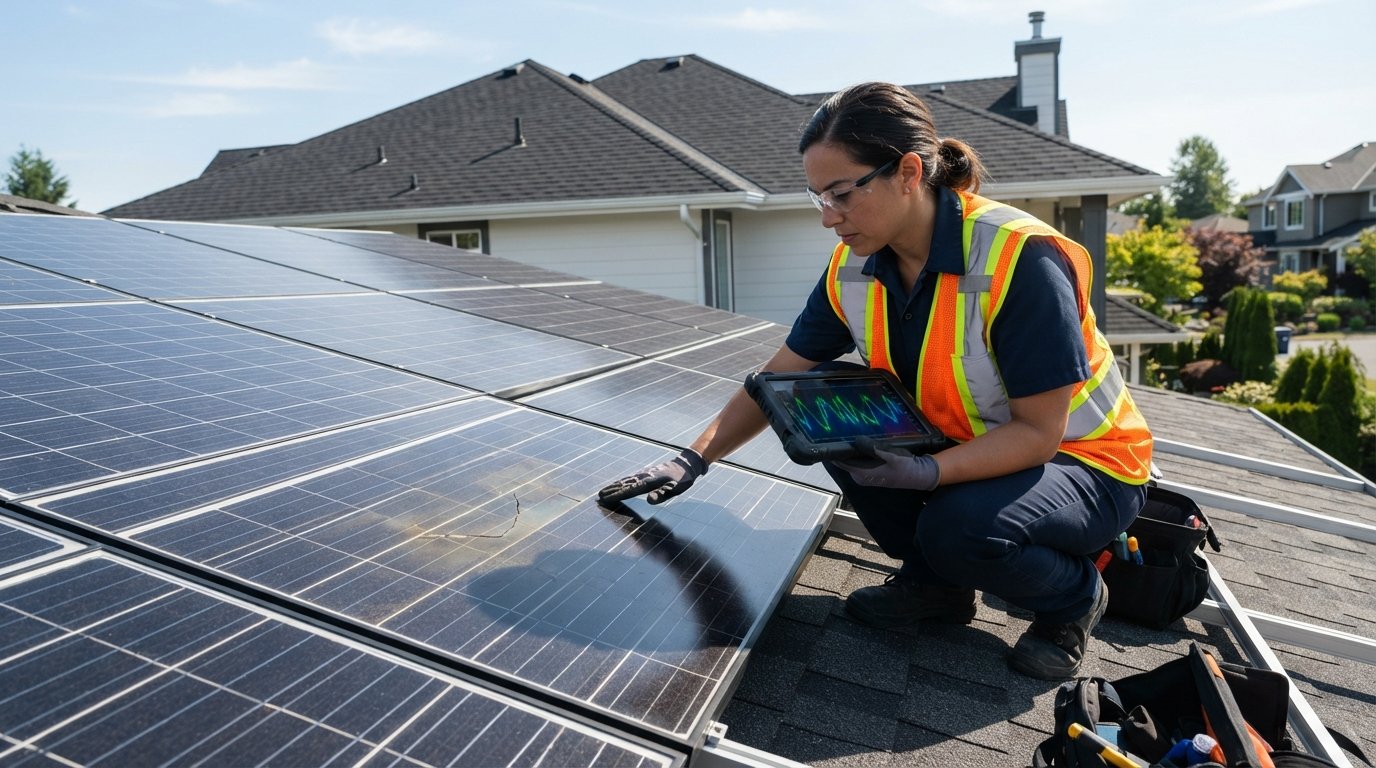
Predictive Maintenance for Solar: Cut Costs, Boost Output
Learn how predictive maintenance can boost your solar system's output, cut unexpected repair costs, and maximize your investment over time.

By Mason Carter
Learn more about Solar Panel Installation and Repair for guides, costs, and what to expect.
Compare Solar Panel Installation and Repair Pros Near You

Enter your ZIP code to compare top-rated local professionals and request free quotes.
Every solar array ages. Panels lose a fraction of efficiency each year, inverters wear down, and connections loosen. For most homeowners, the first sign of trouble is an unexpectedly high electric bill or a system that simply stops working. But what if you could catch that failure before it happens, schedule a repair at your convenience, and avoid the downtime and expense altogether? That is the promise of predictive maintenance, and it is changing how solar system owners protect their investment.
Unlike routine maintenance, which follows a fixed schedule, or reactive maintenance, which waits for a breakdown, predictive maintenance uses data to forecast when a component is likely to fail. It turns maintenance from a guessing game into a precise science. For solar panel owners, this approach can mean the difference between a system that runs at peak efficiency for 25 years and one that gradually underperforms while silently draining your savings.
In this guide, we will explore how predictive maintenance works, why it matters for solar energy systems, and how you can implement it in your own home or business. We will also look at the role of modern monitoring tools, the financial impact, and the practical steps you can take today to start protecting your system.
What Is Predictive Maintenance and How Does It Work?
Predictive maintenance is a data-driven strategy that monitors the condition of equipment in real time and uses analytics to predict when maintenance should be performed. The goal is not to fix things after they break, nor to service them on a rigid timetable, but to intervene at the exact moment when action is most cost-effective.
For solar systems, this involves a network of sensors and software that tracks performance metrics such as energy output, voltage, current, temperature, and even the vibration of moving parts in tracking systems. These data points are analyzed against historical baselines and environmental conditions. When a metric deviates from the expected range, the system flags it as a potential issue. Over time, machine learning algorithms refine these predictions, learning the unique patterns of your specific installation.
For example, a sudden drop in output from one string of panels might indicate soiling, shading, or a failing microinverter. Predictive analytics can distinguish between these causes by cross-referencing weather data and the performance of other strings. The result is a highly specific alert: not just "something is wrong," but "Panel 14 on the south roof has a 90% probability of inverter failure within the next 30 days."
This is a significant departure from traditional maintenance approaches. Scheduled maintenance, while better than doing nothing, often leads to unnecessary service calls and can miss issues that develop between visits. Reactive maintenance, on the other hand, is the most expensive and disruptive option, often resulting in prolonged downtime and costly emergency repairs.
The Growing Importance of Predictive Maintenance in Solar
Solar energy systems are long-term assets. The average payback period for a residential installation in the United States is between 6 and 10 years, and the expected lifespan is 25 to 30 years. Over that time, even a small drop in efficiency can add up to thousands of dollars in lost savings. A 5% reduction in output, for example, might seem minor, but over a decade it could cost you over $1,000, depending on your electricity rates and system size.
Moreover, solar components do not fail at random. They fail according to predictable patterns. Inverters, for instance, have a typical lifespan of 10 to 15 years, and they are the most common point of failure in a residential system. Panels themselves are highly reliable, but their output degrades slowly over time. By understanding these failure patterns, predictive maintenance can identify the warning signs well before a complete breakdown occurs.
The financial case is compelling. A single inverter replacement can cost anywhere from $1,000 to $3,000, including parts and labor. An emergency service call on a weekend can add another $500 to $1,000. Predictive maintenance allows you to plan for these expenses, potentially extending the life of your inverter through timely cleaning or repairs, and avoiding the premium prices that come with urgent calls.
In our guide on predictive maintenance for solar, we delve into specific cost-saving strategies and output optimization techniques that you can apply directly to your system.
Key Components of a Predictive Maintenance Strategy
Implementing predictive maintenance for your solar system does not require a degree in data science. It does require the right tools and a willingness to act on the information they provide. Here are the essential components you will need:
- Monitoring hardware: A solar monitoring system that tracks output at the panel or string level. This can be integrated into your inverter or added as an aftermarket device.
- Data analytics software: A platform that collects data from your monitoring hardware and applies algorithms to detect anomalies. Many modern monitoring systems include this as a built-in feature.
- Alerting system: Notifications via email, SMS, or a mobile app when a potential issue is detected. The key is to have alerts that are specific enough to be useful but not so frequent that they are ignored.
- Maintenance action plan: A clear set of procedures for responding to different types of alerts. This might include steps like cleaning panels, tightening connections, or contacting a professional for a more detailed inspection.
Once these components are in place, the process becomes cyclical. The system collects data, analyzes it, and generates alerts. You respond to those alerts with the appropriate maintenance action. The system then tracks the outcome of that action, which improves its future predictions.
For many homeowners, the easiest way to get started is to work with a professional installer who offers monitoring and maintenance services. A reputable company will have the tools and expertise to set up a predictive maintenance program that is tailored to your specific system.
How Predictive Maintenance Boosts Solar Output
The most direct benefit of predictive maintenance is increased energy production. A well-maintained solar system can produce 5% to 10% more energy over its lifetime compared to a neglected one. This is because even minor issues, left unaddressed, can compound over time.
Consider the impact of soiling. Dust, pollen, bird droppings, and other debris accumulate on panels and block sunlight. In some regions, this can reduce output by as much as 25% if left unchecked for months. Predictive maintenance systems can detect the gradual decline in output that indicates soiling, prompting you to schedule a cleaning at the optimal time. Not too early to waste money, and not too late to lose significant production.
Similarly, shading from overgrown trees or new construction can be identified through performance data. A predictive system might notice that the east array is consistently underperforming during the morning hours, which would indicate a new source of shade. Without this insight, you might never connect the dots until your energy bill spikes.
Beyond cleaning and shading, predictive maintenance can also catch electrical issues. Loose connections, faulty wiring, or failing diodes can cause hotspots that not only reduce output but also pose a fire risk. Early detection allows you to address these problems before they become safety hazards.
To get a better sense of how these strategies play out in real-world scenarios, you can review our solar maintenance and output case studies, which highlight the tangible gains achieved by proactive homeowners.
Implementing Predictive Maintenance at Home
You do not need to be a tech expert to take advantage of predictive maintenance. Here is a step-by-step approach to getting started:
- Assess your current system. Check whether your inverter or monitoring platform already offers predictive features. Many newer models include basic analytics and alerts.
- Upgrade your monitoring if needed. If your system lacks detailed monitoring, consider adding a module-level power electronics (MLPE) system or a third-party monitoring solution. These can provide the granular data needed for accurate predictions.
- Set up alerts. Configure your monitoring app to send notifications for specific events, such as a drop in output or a communication error. Make sure the alerts are actionable and not overly sensitive.
- Create a response plan. Decide in advance what you will do when you receive an alert. Will you clean the panels yourself? Will you call a professional? Having a plan in place prevents panic and ensures quick action.
- Review performance regularly. Even with automated alerts, it is wise to review your system's performance on a monthly basis. Look for trends that might not trigger an immediate alert but could indicate a slow decline.
If you are in the process of installing a new solar system, you have an advantage. You can specify predictive maintenance features from the start, ensuring that your system is fully equipped to monitor its own health. Many installers, including those in the SolarEnergy.ai network, offer monitoring and maintenance packages that include predictive analytics as a standard feature.
The Financial Payoff of Proactive Solar Care
The financial benefits of predictive maintenance extend beyond avoiding repair bills. By keeping your system running at peak efficiency, you are maximizing your return on investment. Every kilowatt-hour of solar energy that you produce is a kilowatt-hour that you do not have to buy from the grid. Over time, these savings compound significantly.
A study by the National Renewable Energy Laboratory found that proper maintenance can increase a solar system's net present value by up to 20%. This is a substantial boost, especially when you consider that the initial investment in solar is already a major financial decision.
Predictive maintenance also offers peace of mind. Instead of worrying about when your inverter might fail, you have a system that tells you when it is starting to degrade, giving you time to budget for a replacement. Instead of waiting for a total system shutdown, you can schedule a repair at a time that suits you, avoiding inconvenience and potential loss of income if your business relies on solar power.
For those seeking to maximize their solar investment, understanding the interplay between maintenance and financial incentives is key. Our article on solar cost reduction and output provides a deeper analysis of how proactive care affects your overall savings.
Overcoming Common Challenges
While predictive maintenance is a powerful tool, it is not without its challenges. One common issue is data overload. Some monitoring systems generate so many alerts that homeowners become desensitized and ignore them. To avoid this, look for systems that use machine learning to filter out false positives and prioritize genuine risks.
Another challenge is the initial cost of advanced monitoring equipment. High-end systems with module-level monitoring and predictive analytics can add several hundred dollars to the upfront cost of a solar installation. However, this expense is often recouped within the first few years through increased energy production and avoided repairs.
Finally, there is the human factor. Even with the best data, predictive maintenance only works if you act on the insights it provides. This means making time for regular reviews, responding to alerts promptly, and scheduling professional maintenance when needed. It is a commitment, but one that pays off handsomely in the long run.
Future Trends in Solar Predictive Maintenance
The field of predictive maintenance is evolving rapidly, driven by advances in artificial intelligence and the Internet of Things (IoT). In the near future, we can expect even more sophisticated systems that can predict failures with higher accuracy, estimate the remaining useful life of components, and even recommend specific actions based on real-time market conditions.
For example, an AI-driven system might not only detect that your inverter is degrading but also calculate the optimal time to replace it based on your electricity rates, the cost of a new inverter, and the expected energy production loss. This level of optimization will make predictive maintenance an even more valuable investment for solar owners.
Moreover, as more homes and businesses adopt solar, the data collected from thousands of systems will allow for benchmarking and predictive models that are incredibly precise. Your system could be compared against similar installations in your area, providing a clear picture of how it is performing relative to the norm.
In the meantime, the principles of predictive maintenance remain accessible to everyone. By investing in quality monitoring, staying engaged with your system's data, and taking proactive action, you can ensure that your solar investment delivers maximum returns for decades to come.
Predictive maintenance is not just a technical concept; it is a practical strategy for protecting your assets and optimizing your energy independence. The sooner you adopt it, the sooner you will see the benefits. Start by reviewing your current monitoring capabilities, consider upgrading if necessary, and make a commitment to proactive care. Your future self, and your wallet, will thank you.