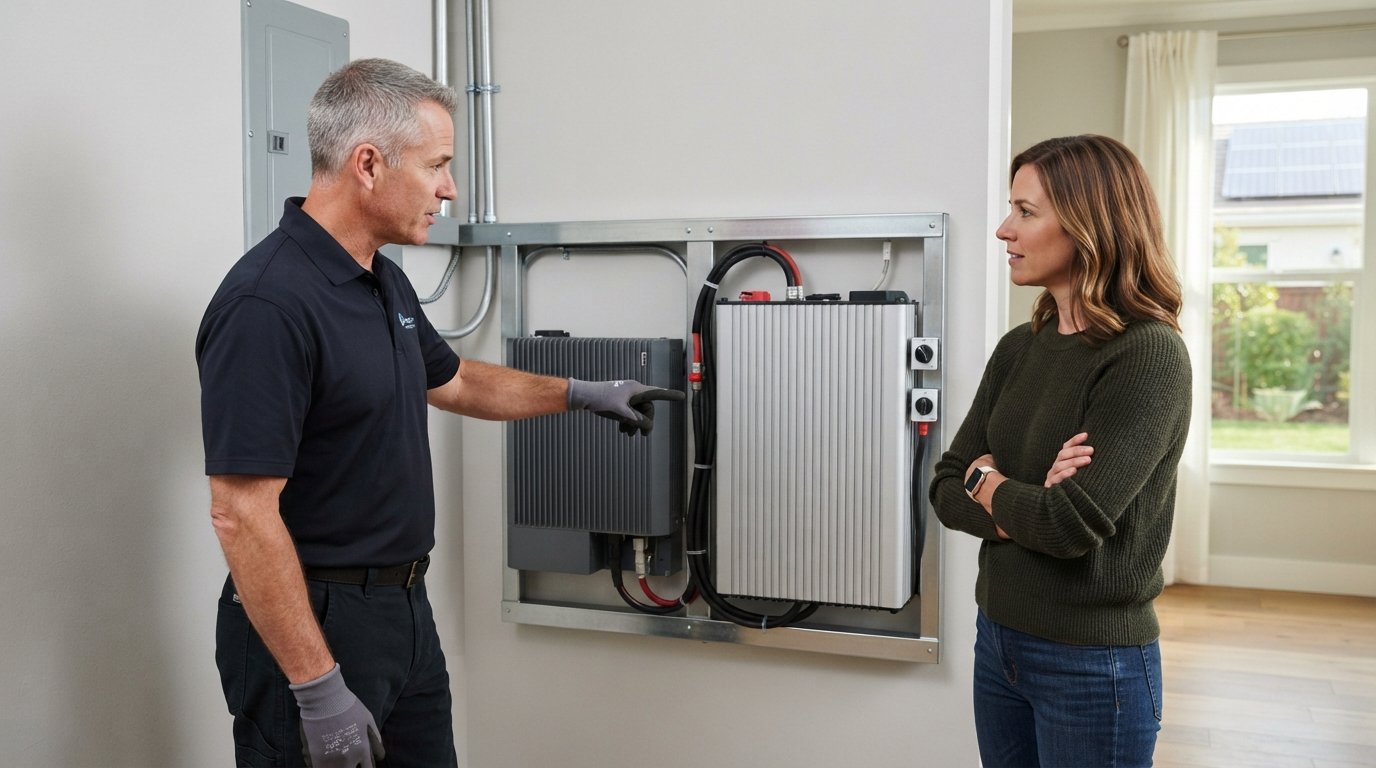
Lithium vs LFP Batteries: Which Solar Storage Wins?
Lithium vs LFP batteries: LFP offers longer life, better safety, and lower lifetime costs, making it the smart choice for home solar storage.

By Owen Phillips
Learn more about Solar Panel Installation and Repair for guides, costs, and what to expect.
Compare Solar Panel Installation and Repair Pros Near You

Enter your ZIP code to compare top-rated local professionals and request free quotes.
Choosing the right battery for your home solar system is one of the most important decisions you will make. It affects how much backup power you have during outages, how much money you save over time, and even the lifespan of your entire renewable energy setup. Two chemistries dominate the market today: lithium-ion (specifically NMC, or nickel manganese cobalt) and lithium iron phosphate (LFP). While they share the word "lithium," their performance, safety, and cost profiles are quite different. In this guide, we break down the Lithium vs LFP batteries debate with a focus on what matters most for homeowners in the United States, so you can choose with confidence.
What Are the Core Differences Between Lithium and LFP Batteries?
Both lithium-ion and LFP batteries store energy through the movement of lithium ions between electrodes. The key difference lies in the cathode material. Traditional lithium-ion batteries use a combination of nickel, manganese, and cobalt (NMC). LFP batteries use iron and phosphate instead. This simple chemical change has profound implications for energy density, thermal stability, cycle life, and cost.
Energy density is a critical metric. Lithium-ion NMC cells pack more energy into a smaller, lighter package. That is why they dominate electric vehicles and consumer electronics. LFP cells are bulkier and heavier for the same capacity. For a home solar installation, where space is usually not a hard constraint, the lower energy density of LFP is rarely a dealbreaker. However, it does mean your battery cabinet will be larger and heavier, which can affect mounting requirements and floor space.
Thermal stability is another major fork in the road. LFP chemistry is inherently more stable. It resists overheating and is far less prone to thermal runaway, the chain reaction that causes battery fires. Lithium-ion NMC batteries are safe when manufactured and managed correctly, but they operate at higher temperatures and require more sophisticated battery management systems (BMS) to prevent failure. For a homeowner, this difference in safety profile can be a decisive factor, especially if the battery is installed inside a garage or living space.
Cycle Life and Longevity: Which Battery Lasts Longer?
Battery lifespan is measured in cycles. One cycle is a full discharge and recharge. LFP batteries typically deliver 4,000 to 6,000 cycles before their capacity drops to 80% of the original. Lithium-ion NMC batteries, on the other hand, usually last for 2,000 to 3,000 cycles under similar conditions. In real-world terms, a daily cycling LFP battery can last 10 to 15 years or more, while an NMC battery may need replacement after 8 to 10 years.
This longevity advantage translates directly into long-term value. A longer cycle life means you will not have to buy a second battery as soon, which reduces the total cost of ownership. For solar homeowners who plan to stay in their homes for decades, LFP's durability is a strong argument. However, the actual lifespan also depends on depth of discharge (DoD) and operating temperature. Most modern systems, regardless of chemistry, are rated for 80% to 100% DoD, but keeping a battery in a hot garage can shorten its life faster than chemistry alone would predict.
Cost Analysis: Upfront Price vs. Total Cost of Ownership
Upfront cost is where lithium-ion NMC historically held an edge, but that gap is closing. As of 2026, LFP batteries are often priced comparably to NMC at the retail level, and in some cases they are cheaper due to falling iron and phosphate prices. The raw materials for LFP are abundant and not subject to the same supply chain volatility as cobalt and nickel, which are mined in politically sensitive regions.
When you factor in lifespan, LFP becomes the clear economic winner. Let's say you pay $10,000 for a 10 kWh LFP battery that lasts 5,000 cycles. Over its life, it delivers 50,000 kWh of throughput. That works out to $0.20 per kWh stored. An NMC battery at the same price but with 3,000 cycles delivers 30,000 kWh, or $0.33 per kWh. Over a 15 year period, the LFP system saves you thousands in avoided replacement costs.
But upfront price is still a barrier for many homeowners. If you need the lowest possible initial investment, an NMC battery might be tempting. However, consider the long game. A cheaper battery that fails after 8 years will cost you more in the long run, both in replacement hardware and installation labor. Use the SolarEnergy.ai solar savings calculator to model both scenarios with your local electricity rates and solar production data.
Hidden Costs and Incentives
Do not forget about incentives. The federal Investment Tax Credit (ITC) currently covers 30% of battery costs when the battery is charged by solar. Some states, like California and Massachusetts, offer additional rebates for energy storage. These incentives apply to both chemistries, but the longer lifespan of LFP means you get more value from the same tax credit. Always check the latest database of state incentives (DSIRE) and verify with your tax advisor, as rules change.
Safety and Thermal Runaway: A Critical Comparison
Safety is a top concern for any homeowner installing a large battery indoors. LFP batteries are widely regarded as the safest lithium-based chemistry. They do not release oxygen during decomposition, which prevents the rapid combustion that characterizes NMC fires. In abuse tests, LFP cells can be punctured or overcharged without catching fire, while NMC cells are more likely to ignite. This does not mean LFP is fireproof, but it offers a much higher margin of safety.
NMC batteries, by contrast, have been involved in high-profile fires in electric vehicles and grid storage sites. When they do fail, the thermal runaway can be violent and difficult to extinguish. Homeowners should also consider the installation environment. If your battery is in a detached garage, the risk to your living space is lower. If it is in a basement or utility closet, LFP's stability is a compelling reason to choose it.
The battery management system (BMS) also plays a role. A good BMS monitors temperature, voltage, and current to prevent unsafe conditions. Both chemistries require a robust BMS, but LFP's chemistry gives the BMS more room to work. It can tolerate brief overvoltage events without immediate danger, whereas NMC systems must react faster to prevent cell damage or failure.
Performance in Extreme Temperatures: Hot and Cold Reality
Temperature affects all batteries. LFP batteries are known to perform well in high heat, which is great for hot climates like Phoenix or Texas. They have a wider operating window, typically from -4°F to 140°F, though performance degrades at the extremes. NMC batteries also operate in a similar range, but they are more sensitive to high temperatures, which can accelerate capacity loss.
In cold weather, both chemistries suffer. LFP has a higher internal resistance, which means it delivers less power when freezing. Some LFP systems include internal heaters to maintain performance, adding a small parasitic load. NMC handles cold slightly better, but not dramatically so. For most U.S. climates, the temperature difference is not a reason to choose one over the other, unless you live in a region with extreme cold and plan to install an outdoor battery without thermal management.
Environmental Impact and Sustainability
If you are going solar to reduce your carbon footprint, the environmental impact of your battery matters. LFP batteries are free of cobalt, which has a notorious history of unethical mining practices and environmental damage. Iron and phosphate are abundant and less toxic. This makes LFP a more sustainable choice from a materials perspective. NMC batteries rely on cobalt and nickel, which are energy-intensive to mine and process.
Recycling is another factor. Both chemistries can be recycled, but LFP is easier and cheaper to recycle because it does not contain valuable heavy metals that require complex extraction. As battery recycling infrastructure improves, LFP's end-of-life value is likely to be higher. For homeowners who care about the full lifecycle of their equipment, LFP aligns better with the ethos of renewable energy.
Scalability and System Design Considerations
When designing a home solar battery system, scalability matters. LFP batteries are available in modular units, like the Tesla Powerwall or LG Chem RESU, which can be stacked to increase capacity. NMC batteries also come in modular form, but their higher energy density means you can pack more capacity into a smaller space. If you have limited wall space, NMC might allow you to install more kWh in a smaller footprint.
However, LFP's modularity is improving. Many manufacturers now offer LFP batteries in slim, wall-mounted designs that are comparable in size to NMC units. The weight difference is still notable, but with proper mounting, it is rarely a limiting factor. Also, consider the inverter compatibility. Most modern hybrid inverters, like those from SolarEdge and Enphase, support both chemistries. Your installer can help you match the battery to your existing or new solar system.
Warranty and Manufacturer Support
Warranty terms are a strong indicator of manufacturer confidence. Most LFP batteries come with a 10-year warranty that guarantees a certain throughput (e.g., 80% capacity after 4,000 cycles). NMC batteries also offer 10-year warranties, but the throughput guarantee is often lower, around 3,000 cycles. Read the fine print. Some warranties exclude thermal abuse or require installation by certified professionals.
SolarEnergy.ai connects you with vetted solar installers who understand the nuances of both chemistries. A professional installer will ensure your battery is correctly sized, wired, and configured to maximize its warranty coverage. They can also advise on whether a specific battery model fits your home's electrical panel and consumption patterns.
Which Battery Should You Choose for Your Home Solar System?
For the vast majority of U.S. homeowners, LFP is the safer, more economical, and more environmentally friendly choice. Its longer cycle life means you will enjoy your solar savings for years longer without replacement costs. Its superior thermal stability reduces fire risk, which is especially important for indoor installations. As of 2026, the upfront price difference between LFP and NMC has narrowed significantly, making LFP the value leader.
There are a few scenarios where NMC might still make sense. If you have extreme space constraints and need maximum energy density in a small footprint, NMC's higher density is an advantage. If you find a deeply discounted NMC system that undercuts LFP by a significant margin, you might consider it, but only if the warranty and cycle life meet your needs. For most people, though, the Lithium vs LFP batteries question now has a clear answer: LFP is the winner for home solar storage.
When you are ready to move forward, use SolarEnergy.ai to find qualified solar pros near you. They can provide quotes for both battery types, explain local incentives, and help you design a system that fits your energy goals. Get a free quote in minutes and start your journey toward energy independence with the right battery.
Learn more about Solar Panel Installation and Repair for guides, costs, and what to expect.
Compare Solar Panel Installation and Repair Pros Near You
Enter your ZIP code to compare top-rated local professionals and request free quotes.