How Long Do Solar Panels Last and What Shortens Their Life?
Most solar panels last 25 to 30 years. Heat, moisture, and poor installation can shorten that life, but smart maintenance protects your investment.

By Dylan Harris
Learn more about Solar Panel Installation and Repair for guides, costs, and what to expect.
Compare Solar Panel Installation and Repair Pros Near You

Enter your ZIP code to compare top-rated local professionals and request free quotes.
Solar panels have become a cornerstone of American home energy strategy, with more than five million installations nationwide and a market that keeps expanding each year. Yet one question consistently rises above the rest when homeowners evaluate a purchase: how long do solar panels last and what shortens their life? The answer shapes everything from your payback period to your long-term return on investment. A typical modern panel will keep producing meaningful electricity for 25 to 30 years, and many continue well beyond that threshold at reduced capacity. But the number on a spec sheet is only half the story. Real-world conditions, installation quality, maintenance habits, and the equipment paired with your panels all influence how closely your system matches its laboratory-rated lifespan. Understanding those variables gives you the power to protect your investment and squeeze every kilowatt-hour from your array.
Understanding the Standard Lifespan of Solar Panels
Most manufacturers rate their panels for a 25 to 30 year operational life, supported by a performance warranty that guarantees a specific output level at the end of that period. The industry standard promises that a panel will still produce at least 80 percent of its original rated power after 25 years. Premium manufacturers sometimes extend that guarantee to 30 years and 85 percent output. In practical terms, this means a 400-watt panel installed today could still deliver roughly 320 to 340 watts in 2051 or 2056.
Degradation happens gradually rather than suddenly. Solar cells lose a small fraction of their efficiency each year, typically between 0.5 and 0.8 percent for modern monocrystalline and polycrystalline panels. That slow decline is why your system's annual production in year 20 will be measurably lower than in year one, even though the difference rarely feels dramatic month to month. For a deeper look at the science behind these numbers, our guide on solar panel lifespan and why panels degrade explains the chemistry and physics at work.
It helps to separate the panel itself from the rest of the system. Inverters, for example, usually need replacement after 10 to 15 years, and batteries may last 8 to 12 years depending on chemistry and usage. So while your panels may be rated for three decades, the complete system will require periodic component swaps to keep performing at its best. Budgeting for those replacements early prevents surprises and keeps your energy production consistent.
Geography also plays a role in how long panels effectively last. A system in Phoenix faces intense heat and ultraviolet exposure, while one in Seattle deals with more rain and cloud cover. Neither environment automatically destroys panels, but each stresses them differently. Homeowners in the Southwest should pay closer attention to thermal management, while those in wetter climates should watch for moisture intrusion and soiling.
What Shortens the Life of Solar Panels?
Several factors can pull a solar panel toward the lower end of its expected lifespan or even push it into early failure. Some are environmental, some are manufacturing-related, and some stem from installation or maintenance decisions. Recognizing them helps you avoid costly mistakes and plan for interventions before damage becomes irreversible.
Heat is perhaps the most underestimated threat. Solar panels actually produce less electricity as temperatures rise above their rated test conditions, and prolonged exposure to extreme heat accelerates the degradation of internal materials. Encapsulants, backsheets, and junction boxes all age faster under sustained thermal stress. In regions where summer temperatures regularly exceed 100 degrees Fahrenheit, panels may degrade at the higher end of the normal range or slightly beyond it.
Moisture intrusion ranks as another leading cause of premature failure. Water that seeps past frame seals or through microcracks in the backsheet can corrode internal connections and cause ground faults. Once moisture reaches the circuitry, performance drops and safety risks increase. Proper installation with quality flashing and sealants is your first line of defense, and periodic inspections catch small breaches before they become systemic.
Physical damage from hail, wind-borne debris, fallen branches, or even careless foot traffic during maintenance can crack cells or break glass. A single cracked cell may not kill an entire panel, but it creates a hot spot that drags down the performance of the whole string. Rodents chewing on wiring and birds nesting under panels can also cause damage that shortens equipment life.
Poor installation quality is a silent killer of solar investments. Panels mounted too close to the roof surface trap heat and reduce airflow. Improperly torqued connections loosen over time and create resistance that generates heat. Inadequate grounding invites electrical hazards. These issues may not appear in the first year, but they compound and can cut years off your system's useful life.
Finally, manufacturing defects and quality control failures occasionally slip through even reputable brands. Potential-induced degradation, light-induced degradation, and faulty bypass diodes are examples of issues that can emerge within the warranty period. This is why choosing a manufacturer with a strong track record and a robust warranty matters as much as choosing the right panel type.
Environmental and Installation Factors That Matter
The environment surrounding your panels influences their longevity in ways that are not always obvious. Dust, pollen, and agricultural debris accumulate on the glass surface and reduce light transmission. If left unchecked, heavy soiling can also trap moisture and create conditions for mildew or etching. In snowy regions, ice dams and snow loads stress mounting hardware, while in coastal areas, salt spray accelerates corrosion of frames and mounting brackets.
Shade is another factor that affects both performance and lifespan. When part of a panel is shaded, the shaded cells can become resistive loads rather than power producers, generating heat that degrades materials over time. Bypass diodes mitigate this effect, but chronic shading still takes a toll. Trimming trees and planning array placement carefully reduces this risk.
Installation angle and orientation also play a role. Panels mounted at an optimal tilt shed water and debris more effectively than flat-mounted arrays. They also benefit from better convective cooling. Roof-mounted systems on sloped surfaces generally outperform flat roof systems in terms of both output and longevity, all else being equal.
Here are the primary environmental and installation stressors to monitor:
- Extreme heat and thermal cycling that accelerate material degradation
- Moisture intrusion through seals, frames, or damaged backsheets
- Physical impact from hail, debris, or wildlife
- Chronic shading that creates hot spots and resistive heating
- Poor mounting practices that restrict airflow or invite corrosion
Each of these factors is manageable with thoughtful design and routine care. The key is to address them proactively rather than reactively. A system installed with longevity in mind will consistently outperform one where shortcuts were taken.
How Maintenance and Monitoring Extend Panel Life
Solar panels are famously low-maintenance, but low-maintenance does not mean no maintenance. A simple annual routine can add years to your system's productive life and protect your warranty. Cleaning panels once or twice a year removes soiling that reduces output and traps moisture. Inspecting mounting hardware, wiring, and junction boxes catches small problems before they escalate. Checking inverter performance data alerts you to declining output that might indicate a panel issue.
Monitoring systems have become increasingly sophisticated. Modern inverters and smart meters provide real-time data on production, and AI-driven platforms can flag anomalies that suggest a failing panel or a shading issue. Acting on those alerts quickly often means the difference between a minor repair and a major replacement.
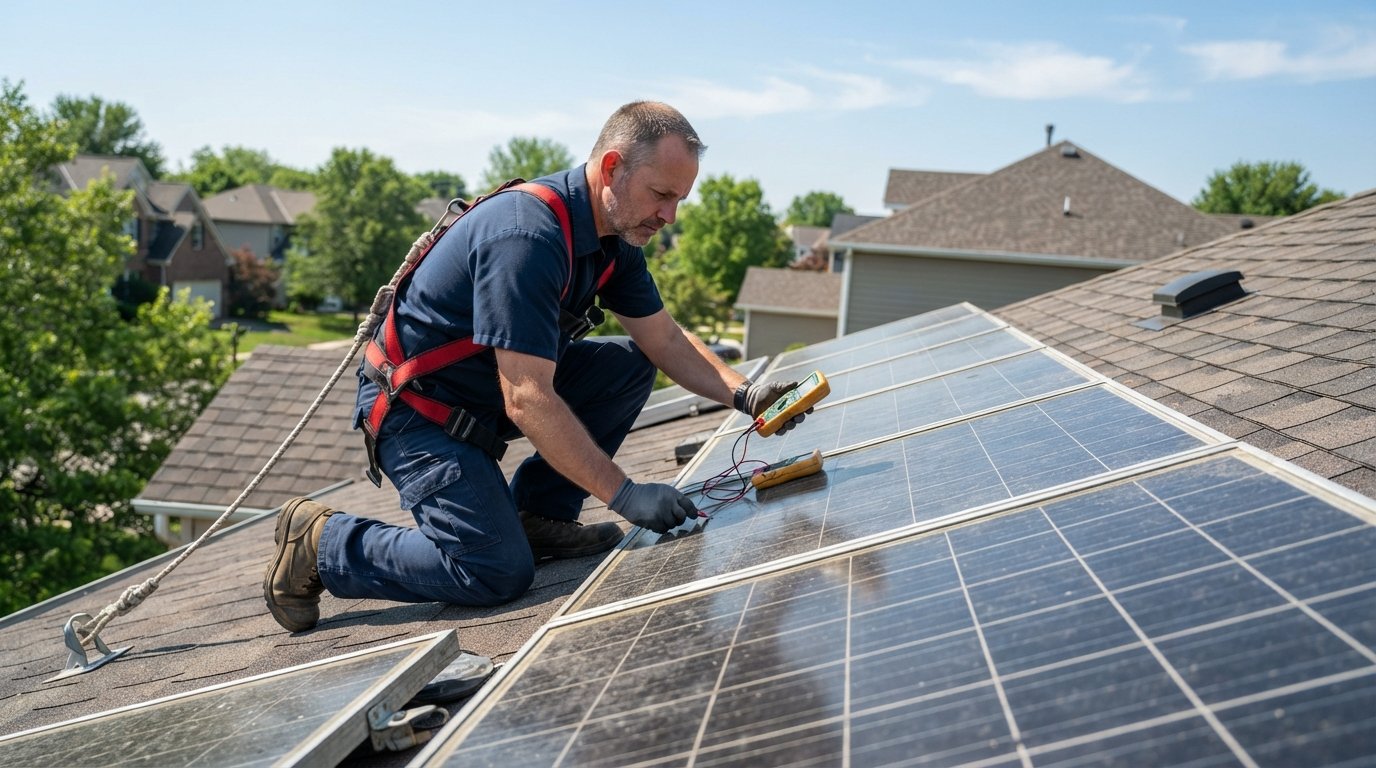
Professional inspections every three to five years are worth the modest cost. Technicians can detect microcracks, thermal anomalies, and electrical issues that are invisible to the naked eye. They can also verify that your system is still operating within warranty parameters. If you need help finding qualified professionals, platforms like NewSolarQuotes connect homeowners with vetted solar specialists who understand the nuances of long-term system care.
It is also wise to keep records of all maintenance, repairs, and performance data. If you ever need to file a warranty claim, documentation strengthens your case. It also helps future buyers understand the system's history if you sell your home.
When to Repair, Replace, or Upgrade
Eventually, every solar system reaches a point where repair or replacement becomes the more sensible choice. The decision depends on the panel's age, its current output, the cost of replacement versus the value of continued production, and whether newer technology offers a meaningful upgrade. Panels that are 20 years old and producing at 75 percent of rated capacity may still be economically viable, especially if your electricity rates are high. Panels that are 12 years old and failing due to manufacturing defects are a different story.
Inverters typically need replacement before panels do. If your inverter fails and your panels are already 15 years old, it may make sense to replace both at once rather than invest in a new inverter for aging panels. Similarly, if you are adding battery storage or expanding your array, upgrading to newer, more efficient panels can improve overall system performance.
Repair is often the right call for isolated damage such as a cracked panel or a faulty connection. Replacing a single panel is straightforward if matching models are available. If they are not, you may need to replace an entire string to maintain electrical compatibility, which shifts the calculus toward a broader upgrade.
Upgrading also opens the door to newer technologies that did not exist when your original system was installed. Bifacial panels, for example, capture light from both sides and can boost output by 5 to 15 percent in the right conditions. Higher-efficiency cells mean you can generate more power from the same roof area. If your energy needs have grown, an upgrade may be the most cost-effective way to meet them.
Maximizing Your Solar Investment Over Decades
Protecting your solar investment starts with informed choices at the beginning. Selecting high-quality panels from reputable manufacturers, hiring experienced installers, and designing your system for your specific climate and roof conditions all set the stage for a long, productive life. After installation, a modest commitment to maintenance and monitoring keeps performance high and catches issues early.
Financial planning matters too. Understanding your warranty terms, knowing when components like inverters will need replacement, and setting aside a small reserve for future maintenance prevents financial strain. Taking advantage of federal, state, and local incentives reduces your upfront cost and shortens your payback period, making the long-term math even more attractive.
Solar technology continues to improve, and the panels installed today are more durable and efficient than those from a decade ago. With proper care, a system installed in 2026 could still be generating meaningful power in the 2050s. That is decades of reduced electricity bills, lower carbon emissions, and greater energy independence. The key is to treat your solar array as the long-term asset it is, and to give it the attention it needs to deliver on its promise.