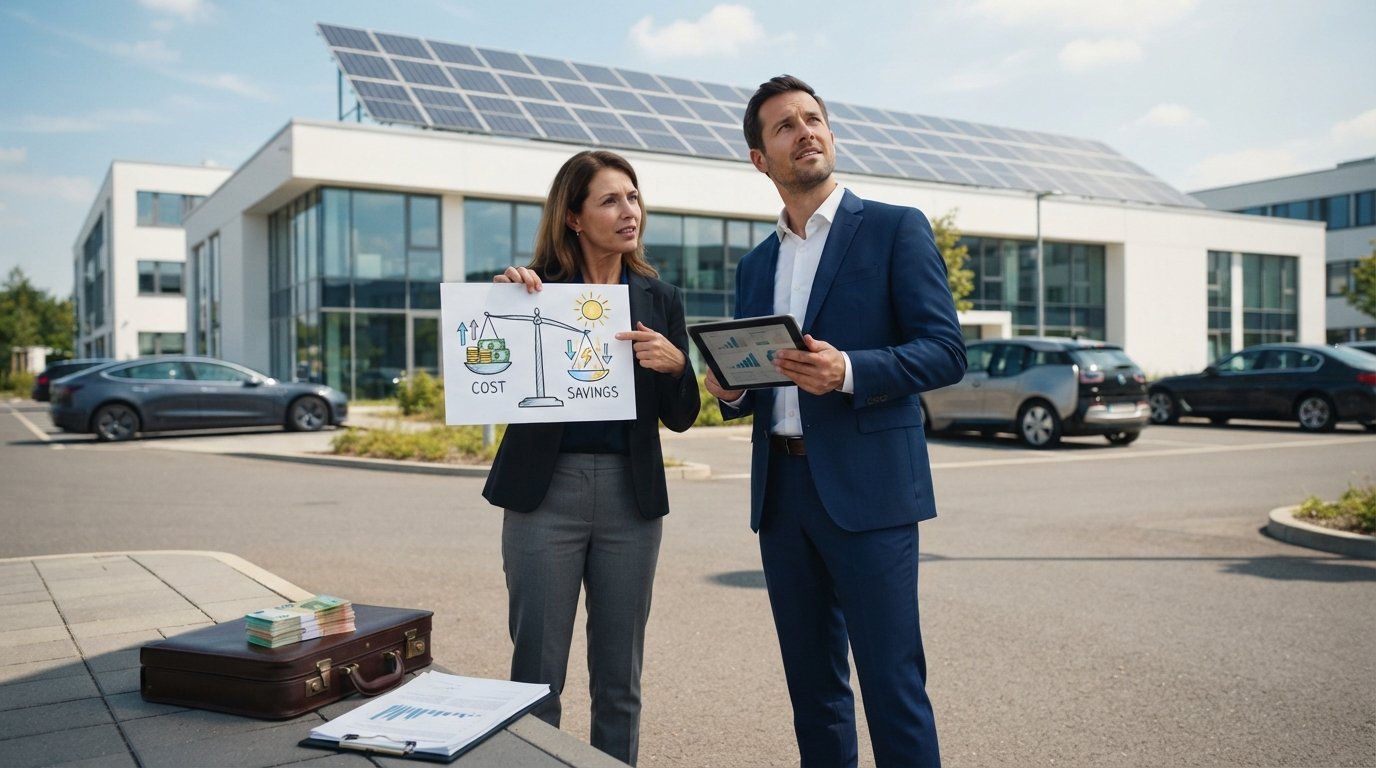
Commercial Solar Lease vs Purchase: Which Is Better?
Compare commercial solar lease vs purchase to see which financing option delivers the highest long-term savings for your business.

By Ryan Brooks
Learn more about Solar Panel Installation and Repair for guides, costs, and what to expect.
Compare Solar Panel Installation and Repair Pros Near You

Enter your ZIP code to compare top-rated local professionals and request free quotes.
For a business owner, the decision to go solar is rarely about whether clean energy is a good idea. The real question is almost always financial: how do you pay for it? The two dominant paths, a commercial solar lease and an outright purchase, lead to very different outcomes for your balance sheet, your tax situation, and your long-term savings. Choosing wrong can mean leaving thousands of dollars on the table or locking your company into a 20-year agreement that limits flexibility. This guide breaks down the true costs, benefits, and risks of each option so you can make a confident, informed choice for your business.
The Core Financial Difference: Ownership vs. Service
At the most basic level, a commercial solar lease vs purchase comparison comes down to who owns the system. When you purchase, you own the panels, inverters, and racking outright. You pay the full upfront cost (or finance it with a loan), and you receive all the financial benefits: the electricity savings, the federal Investment Tax Credit (ITC), and any state or local incentives. When you lease, a third-party developer owns the system. You pay a fixed monthly fee for the electricity it generates, and the developer keeps the tax credits and incentives. In exchange, you get a lower monthly energy bill with little to no upfront investment.
This distinction matters far beyond simple ownership. It affects who is responsible for maintenance, what happens if your business moves, and how the system appears on your financial statements. A lease is often treated as an operating expense, while a purchase is a capital asset that can be depreciated. For many businesses, that accounting difference alone can tip the scales toward one option or the other.
Cash Flow and Upfront Costs: The Immediate Impact
The most obvious advantage of a lease is the lack of upfront capital. A commercial solar installation can cost anywhere from $100,000 to over $1 million depending on the size of your facility. For many businesses, that is a significant chunk of cash that could be used for inventory, hiring, or marketing. A lease eliminates that hurdle entirely. You simply sign the agreement and start paying a monthly fee that is typically lower than your current utility bill. This is the classic "$0 down" approach that makes solar accessible to businesses that do not have the capital reserves to buy a system outright.
However, the short-term savings of a lease come at a long-term cost. When you purchase, your monthly "payment" (if you finance) is temporary. Once the loan is paid off, your electricity is essentially free for the remaining 15 to 20 years of the system's life. With a lease, you pay for the system for the entire duration of the agreement, and the monthly fee typically escalates by 1% to 3% each year. Over a 20-year period, the total lease payments can easily exceed the cost of purchasing the system outright, even after accounting for the time value of money.
Calculating Your Break-Even Point
To see which option makes sense for your business, you need to calculate your break-even point. For a purchase, this is the number of years it takes for your electricity savings to equal the upfront cost. For a lease, the break-even is less relevant because you never own the asset, but you should still compare the total lease payments against the value of the electricity you would have bought from the utility. A simple rule of thumb: if your business plans to stay in the same location for 10 years or more, a purchase usually wins. If you are unsure about your long-term plans, a lease offers more flexibility.
Let's look at a concrete example. A warehouse in Phoenix installs a 100 kW system. The purchase cost is $250,000 after applying the federal tax credit. The system saves $30,000 per year in electricity costs, so the payback period is about 8.3 years. Over the system's 25-year life, the business saves $750,000 in electricity, minus the initial $250,000, for a net gain of $500,000. Under a lease, the same system might cost $2,000 per month with a 2% annual escalator. Over 20 years, the total lease payments would be roughly $580,000, but the electricity savings are only $600,000 (assuming rates stay flat, which is unlikely). The net gain is just $20,000, and you have nothing to show for it at the end. This stark difference is why many financial advisors recommend a purchase for businesses with stable, long-term occupancy.
Tax Credits and Incentives: Who Gets the Benefits?
The federal Investment Tax Credit (ITC) is one of the most valuable incentives in the solar industry. It allows you to deduct 30% of the system cost from your federal taxes. For a $250,000 system, that is a $75,000 credit. When you purchase, this credit is yours. When you lease, the developer claims the ITC, and they use it to lower your monthly payments. This is why lease payments can be so attractive: the developer is effectively sharing the tax benefit with you.
However, the ITC is not the only incentive. Many states offer additional rebates, performance-based incentives, or property tax exemptions. In some cases, these incentives are also claimed by the lease provider, not the business. It is essential to read the lease agreement carefully to understand exactly which incentives you are entitled to. If your business has a large tax liability, purchasing the system and claiming the ITC yourself can dramatically improve your ROI. If your business has little or no tax liability, a lease may be the only way to access solar savings, since you cannot benefit from a tax credit you cannot use.
Maintenance and Performance Risk
One of the most significant advantages of a lease is that the developer is responsible for maintenance and repairs. If an inverter fails or a panel is damaged, the lease company fixes it at no cost to you. This is a major peace of mind benefit, especially for businesses that do not have the in-house technical expertise to manage a solar array. The lease agreement typically includes performance guarantees, so if the system does not produce the promised amount of electricity, the developer compensates you for the shortfall.
With a purchase, all maintenance and repair costs fall on your business. Solar panels are generally low-maintenance, but inverters typically need replacement after 10 to 15 years, at a cost of several thousand dollars. You also need to budget for periodic cleaning and inspections. For some businesses, this added responsibility is a dealbreaker. But it is worth noting that the long-term savings from a purchase usually far outweigh these occasional costs. A good rule is to set aside 0.5% to 1% of the system cost per year for maintenance, which still leaves you ahead compared to a lease.
Flexibility and Exit Options
Another critical factor in the commercial solar lease vs purchase debate is what happens if your business changes. With a purchase, the solar system is attached to your building, and it adds value to the property. If you sell the building, you can sell the solar system along with it, often at a premium. If you move, you can potentially take the system with you, though the cost of removal and reinstallation can be high.
With a lease, your options are more limited. Most leases have a 20-year term, and they are tied to the property, not the business. If you sell the building, the new owner must assume the lease, which can be a point of negotiation. If the new owner does not want the lease, you may have to buy out the remaining payments, which can be expensive. Some leases include a clause that allows you to purchase the system at fair market value after a certain number of years, but this is not guaranteed. Before signing a lease, always review the exit clauses and understand your obligations if you need to terminate early.
Long-Term Savings and ROI: The Final Verdict
When you compare the total cost of ownership over the system's lifetime, a purchase almost always delivers a higher return on investment. A study by the National Renewable Energy Laboratory found that the levelized cost of energy from a purchased solar system is significantly lower than from a leased system, primarily because the owner captures all the incentives and avoids the escalation clauses in leases. For businesses with a 10-year or longer planning horizon, the financial case for purchasing is compelling.
However, a lease is not without merit. It provides immediate savings with zero upfront cost, and it transfers all technical and performance risk to the developer. For businesses that are capital-constrained, have uncertain long-term plans, or do not have the tax appetite to use the ITC, a lease can be a smart strategic choice. The key is to model both scenarios with your actual electricity usage, current rates, and projected rate increases. Tools like the Solar Savings Calculator can help you estimate your potential savings under different ownership models.
One common misconception is that a lease is the only way to get solar with no money down. In fact, many solar loans offer $0 down financing, allowing you to own the system and still avoid a large upfront payment. The interest on the loan is often lower than the escalation in a lease, and you still claim the ITC. This hybrid approach can give you the best of both worlds: ownership benefits with manageable monthly payments. When evaluating your options, be sure to compare leases against solar loans, not just cash purchases.
Making the Decision: A Practical Framework
To help you decide, work through this simple checklist. First, determine your business's tax liability. If you have a significant federal tax bill, purchasing is likely the better choice. Second, assess your cash flow. If you cannot afford the upfront cost and do not qualify for a loan, a lease may be your only option. Third, consider your plans for the property. If you expect to stay for 10 years or more, purchase. If you might move or sell, lease. Fourth, compare the total cost of each option over 20 years, including the time value of money. Finally, consult with a tax advisor and a solar professional who can provide a detailed quote for your specific site.
There is no one-size-fits-all answer to the commercial solar lease vs purchase question. Your decision will depend on your unique financial situation and business goals. However, by understanding the trade-offs between ownership and service, you can choose the path that maximizes your long-term savings and aligns with your strategic objectives.
Resources for Your Solar Journey
Once you have decided on a financing model, the next step is finding a reputable solar installer. SolarEnergy.ai can connect you with vetted solar professionals in your area who can provide detailed proposals and help you navigate the complexities of incentives and financing. Additionally, resources like NewSolarQuotes offer independent educational content and cost calculators that can help you benchmark your quotes and understand the solar market in your region. Always compare multiple proposals and ask each installer to model both a lease and a purchase scenario so you can see the numbers side by side.
In the end, the best choice is the one that fits your business's cash flow, tax situation, and long-term goals. Whether you lease or purchase, going solar is a smart move for reducing operating costs and building energy resilience. For a deeper dive into how modern software can streamline your solar project management, see our guide on why commercial solar software is a game changer. The sooner you start the process, the sooner you can start saving.