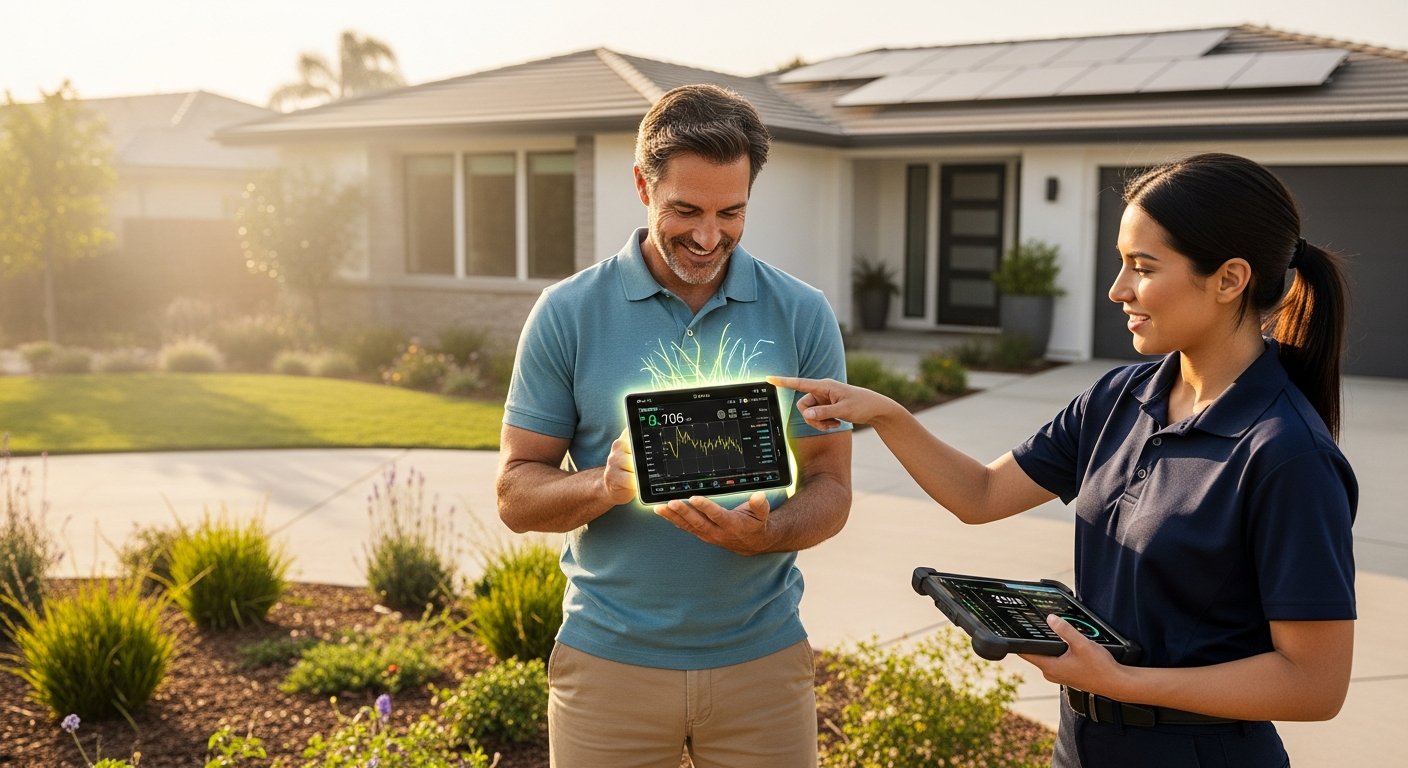
AI Solar Monitoring: Boost Your Home Savings
AI solar monitoring detects panel issues in real time, preventing costly repairs and boosting your home energy savings.

By Mason Carter
Learn more about Solar Panel Installation and Repair for guides, costs, and what to expect.
Compare Solar Panel Installation and Repair Pros Near You

Enter your ZIP code to compare top-rated local professionals and request free quotes.
Your solar panels are generating power every day, but are you truly maximizing every kilowatt-hour? Traditional monitoring provides basic data, but it often misses subtle performance drops that cost you money. AI solar monitoring changes that by analyzing your system's data in real time, detecting anomalies, and predicting maintenance needs before they become expensive problems. This technology turns your solar array into a smart asset that actively works to optimize your savings.
How AI Solar Monitoring Transforms Your Energy System
AI solar monitoring uses machine learning algorithms to process vast amounts of data from your solar panels, inverters, and environmental sensors. Unlike standard monitoring that simply reports energy output, AI systems learn the unique performance patterns of your installation. They compare real-time production against historical baselines, weather forecasts, and satellite imagery to identify even minor inefficiencies. For example, if a single panel underperforms due to a small crack or debris buildup, the AI flags it instantly. This level of precision is impossible with manual checks alone. In our comparison of AI versus manual solar monitoring, we explain how automated alerts outperform human observation.
The system also accounts for variables like shading from nearby trees, cloud cover, and seasonal angle changes. Over time, the AI builds a detailed model of your energy production, allowing it to predict future output with remarkable accuracy. This predictive capability helps you plan for usage spikes, battery charging, and even grid export strategies. By automating these insights, AI solar monitoring removes guesswork and empowers homeowners to make data-driven decisions about their energy consumption.
Key Benefits of AI Solar Monitoring
Adopting AI-driven oversight for your solar system delivers tangible advantages that go beyond basic monitoring. These benefits directly impact your bottom line and extend the life of your equipment. Here are the primary ways AI solar monitoring adds value:
- Early fault detection -- The AI identifies underperforming panels, inverter issues, or wiring problems days or weeks before they would be noticed during manual inspection. This early warning prevents small issues from escalating into costly repairs.
- Predictive maintenance -- By analyzing trends, the system can forecast when components are likely to fail. You receive proactive alerts to schedule maintenance, avoiding unexpected downtime and preserving your warranty.
- Energy production optimization -- The AI adjusts settings in real time based on weather and grid conditions. It might recommend trimming nearby trees or cleaning panels to restore lost efficiency.
- Financial insights -- Detailed reporting shows exactly how much money each panel generates, how your savings compare to previous months, and what your return on investment looks like. This data is invaluable for budgeting and for verifying utility bill credits.
Each of these benefits translates to a more reliable system and higher long-term savings. For instance, homeowners who catch a failing inverter early can replace it under warranty rather than paying out of pocket. Over a 25-year solar lifespan, these savings can amount to thousands of dollars. Solar monitoring tools with AI offer granular insights into panel performance, as detailed in our guide.
Realizing the Financial Impact
The financial case for AI solar monitoring is compelling. A typical residential solar system loses 5 to 15 percent of its expected output due to unaddressed issues like panel soiling, shading, or inverter degradation. AI monitoring can reduce that loss to under 2 percent by ensuring quick detection and resolution. If your system produces 10,000 kWh annually and electricity costs $0.15 per kWh, even a 5 percent performance drop costs $75 each year. Over 25 years, that is $1,875 in lost savings. AI monitoring eliminates that waste, often paying for itself within the first year.
Additionally, AI helps you take full advantage of time-of-use rates and net metering. It can automatically shift heavy energy consumption to periods of peak solar production, reducing your reliance on grid power during expensive rate windows. Some advanced systems even integrate with smart home devices to run appliances, charge electric vehicles, or discharge batteries at optimal times. These coordinated actions amplify your overall energy independence.
Integrating AI Monitoring with Your Home Energy Strategy
AI solar monitoring does not exist in isolation. It works best when paired with a comprehensive home energy management ecosystem. Start by choosing a monitoring platform that supports your specific inverter and panel types. Many newer systems come with built-in AI capabilities, while older installations can be retrofitted with add-on sensors and cloud-based software. When evaluating options, consider factors such as mobile app usability, alert customization, data export options, and compatibility with battery storage systems.
Once your AI monitoring is active, treat its insights as a roadmap for continuous improvement. For example, if the system shows recurring afternoon shading, you might adjust your panel tilt or trim vegetation. If inverter performance declines during heatwaves, you could add ventilation or move the inverter to a cooler location. The AI helps you prioritize which actions will deliver the highest return. Our article on AI solar monitoring for home savings outlines real-world results from homeowners who followed these strategies.
Making the Switch to Intelligent Solar Management
Transitioning to AI solar monitoring is straightforward for most homeowners. Start by reviewing your current solar monitoring setup. Do you receive alerts when a panel goes offline? Can you view historical production trends by hour? If not, upgrading to an AI-enabled platform can bridge that gap. Many providers offer free or low-cost software updates that add machine learning features to existing hardware. For those installing a new system, ask your installer about AI-ready inverters and monitoring packages.
Once installed, spend time familiarizing yourself with the dashboard. Set up notifications for critical events like inverter failures or sudden output drops. Review weekly performance summaries to stay aware of any emerging trends. Over time, the AI will learn your routines and become even more effective at optimizing your energy use. You can also share access with a trusted solar technician who can respond quickly to any issues flagged by the system.
The impact on your household goes beyond financial savings. AI solar monitoring reduces stress by eliminating the need for constant manual checks. You gain peace of mind knowing that your investment is being protected around the clock. It also supports broader sustainability goals by ensuring your solar array operates at peak efficiency, generating more clean energy and reducing your carbon footprint. For many homeowners, this technology represents the next logical step in their renewable energy journey.
As the residential solar market matures, AI monitoring is becoming a standard feature rather than a luxury addition. Early adopters are already reporting higher satisfaction and faster payback periods. By embracing this intelligent approach, you can unlock the full potential of your solar power system and enjoy greater savings for decades to come.